Statute of Limitation on debts


What is Statute of Limitation?

The Statute of Limitation is the maximum time limit for a creditor to file a lawsuit in federal courts to claim the outstanding amount against a fraudulent debtor. If the lawsuit is not filed within the stated time limit, the creditor will loose the right to claim or sue for it forever. That means the debt collector will no longer have any right to sue you for payment of old debt. If a debt collector still threatens to sue you, he will be punished for violating the Fair Debt Collection Practices Act. Usually the SOL time limit lies between 3-10 years after the moment you signs up a credit contract or the last activity date written on your credit report.

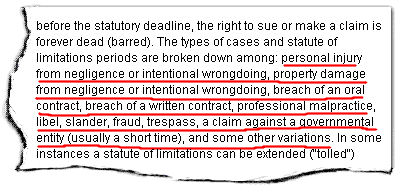
According to Law.com Dictionary, the cases type and the statute of limitation includes

The purpose of the Statute of Limitation is to ensure that a debtor will not worry about being sued by the creditor for the rest of his life and he gets a chance to defend himself with new evidence. This does not ensure that a creditor will not be able to sue you. If a creditor does that, you can ask the judge to dismiss the case on the ground of expired time period. The Statute of Limitation does not hold for certain type of debt such as Federal Student loans, most types of fines, past due child support (depending on states).

The statute of limitation on debt depends upon the following:

  • The amount of debt you owe.
  • Your State’s civil debt collection code.

Statute of Limitation in the United States

The chart below depicts the Statute of Limitation in different states of the United States. If you want to know specific details on any account, you can contact your State’s Attorney General Office.

Oral Contract: You agree to pay money loaned to you by someone, but this contract or agreement is verbal (i.e., no written contract, "handshake agreement"). Remember a verbal contract is legal, if tougher to prove in court.

Written Contract: You agree to pay on a loan under the terms written in a document, which you and your debtor have signed.

Promissory Note: You agree to pay on a loan via a written contract, just like the written contract. The big difference between a promissory note and a regular written contract is that the scheduled payments and interest on the loan also is spelled out in the promissory note. A mortgage is an example of a promissory note.

Open-ended Accounts: These are revolving lines of credit with varying balances. The best example is a credit card account.

Statute of Limitation Chart
State Written Contracts Oral Agreements Promissory Notes Open-ended Accounts
Alabama 6 6 6 3
Alaska 6 6 6 6
Arizona 6 3 5 3
Arkansas 5 3 6 3
California 4 2 4 4
Colorado 6 6 6 6
Connecticut 6 3 6 6
Delaware 3 3 6 3
D.C. 3 3 3 3
Florida 5 4 5 4
Georgia 6 4 6 4
Hawaii 6 6 6 6
Idaho 5 4 10 4
Illinois 10 5 6 5
Indiana 10 6 10 6
Iowa 10 5 5 5
Kansas 5 3 5 3
Kentucky 15 5 15 5
Louisiana 10 10 10 3
Maine 6 6 6 6
Maryland 3 3 6 3
Massachusetts 6 6 6 6
Michigan 6 6 6 6
Minnesota 6 6 6 6
Mississippi 3 3 3 3
Missouri 10 5 10 5
Montana 8 5 8 5
Nebraska 5 4 6 4
Nevada 6 4 3 4
New Hampshire 3 3 6 3
New Jersey 6 6 6 6
New Mexico 6 4 6 4
New York 6 6 6 6
North Carolina 3 3 5 3
North Dakota 6 6 6 6
Ohio 15 6 15 ?
Oklahoma 5 3 5 3
Oregon 6 6 6 6
Pennsylvania 6 4 4 6
Rhode Island 15 15 10 10
South Carolina 10 10 3 3
South Dakota 6 6 6 6
Tennessee 6 6 6 6
Texas 4 4 4 4
Utah 6 4 6 4
Vermont 6 6 5 6
Virginia 5 3 6 3
Washington 6 3 6 3
West Virginia 10 5 6 5
Wisconsin 6 6 10 6
Wyoming 10 8 10 8

Statute of Limitations on Judgments

The question of judgement comes up when a creditor files a lawsuit to recover the outstanding amount from the debtor. They must sue the debtor before the SOL time limit expired. At this time, the court will contact you via mail. The creditor will need to proof that the debt is actually owed. Once judgement is passed, the creditor has every right to seize your assets, bank accounts or garnish wages.

Statute of Limitations on Judgments
State SOL (Years) Maximum Interest Rate (%)
Alabama 20 12
Arkansas 10 10.5
Alaska 5 10
Arizona 10 Fed + 5
California 10 10
Colorado 20 8
Connecticut 20 10
Delaware No Limit Legal + Fed Discount + 5
D.C. 3 70% of interest rate
or 6% if not specified
Florida 20 10
Georgia 7 12
Hawaii 10 10
Iowa 6 10.875
Idaho 20 9
Illinois 20 8
Indiana 20 10
Kansas 5 4% above Fed Discount
Kentucky 15 12
Louisiana 10 9
Maine 20 7.5
Maryland 12 15% if under 30 months,
T-bill rate if over 30 months
Massachusetts 20 10
Michigan 10 20
Minnesota 10 6.953
Mississippi 7 5% changes yearly
Missouri 10 Amount in contract
Montana 10 9
North Carolina 5 10
North Dakota 6 1% above bond equiv Yield
Nebraska 20 2% above Prime
New Hampshire 20 10
New Jersey 14 No provisions
New Mexico 20 8.75% without written contract
Nevada 10 9
New York 10 8
Ohio 21 12
Oklahoma 5 10
Oregon 10 4% over T-bill
Pennsylvania 4 9% renewable @10 yrs
Rhode Island 20 6
South Carolina 10 12
South Dakota 20 14
Tennessee 10 10
Texas 10 10
Utah 8 can be 18% w/Agreement
or 6% without
Virginia 8 Judgement Contract Rate
Vermont 20 12
Washington 10 9
Wisconsin 10 12
West Virginia 20 10
Wyoming 5 12

The information is given above is believed to be correct at the time of creation of the page and is for reference purpose only. If you find any information incorrect, you can get it verified with your state Attorney General.


Ask Nelly on this topic
Name (optional)

Subject (optional)

Message


Thread Tools
Search this Thread
Display Modes

  #1  
06-28-2008, 06:12 AM
vashti108 vashti108 is offline
Join Date: Jun 2008
Posts: 1
Credits: 147
Sub: Statute of Limitation on debts

Hi,

I received a court summons for 2500 on one debt and I am worried about seizure of assets and how to fight this. I don't have much money to negotiate with, but I also think this debt has reached California Statute of limitations (4 years) but I don't know what to do, as far as going to court, filling out a response etc. Can anyone help out?

Vashti
Reply With Quote Quick reply to this message
  #2  
06-28-2008, 09:04 AM
NASCAR_Devil's Avatar
NASCAR_Devil NASCAR_Devil is offline

Moderator
Join Date: Jun 2008
Location: Texas
Posts: 4,585
Credits: 27,975
Sub:

Welcome to the forum Vashti!
Take a deep breath and don't panic!

If you do nothing else, you must show up on your court date or a default judgement will be awarded and then you have a whole new set of problems.

Can you provide a bit more info on this, it will help us to give you the best advice possible:

1. Are you being sued by the original creditor (OC)or a junk debt buyer (JDB)?- plaintiff on your summons

2 If a JDB, who is the OC?

3. Have you verified the summons with your county courts? in person or via their website

4. Have you had any prior communication with the people suing you? prior collection notices, etc

5. When was the last time you made a payment on the account? - important for determining if SOL has indeed expired

6.Did they send anything else with the summons? Affadavit, a statement from the OC, interrogatories..etc

I and a lot of other members have been/are where you're at and the advice recieved on this type of board can be invaluable for helping you with your defense. I know it helped me when I was sued.
Reply With Quote Quick reply to this message
  #3  
06-29-2008, 05:29 AM
Anonymous
Guest
Posts: n/a
Credits: 0 [Check]
Sub:

1. Junk Debt Buyer

2. JDB: lvnv funding llc

3. No

4. Prior Collections Notices

5. I looked at SOL and last payment date. They are out of the SOL if a return doesn't count. I made one return 4 days after the 4 year limit. It is not a payment. The last payment was the month before they filed.

6. A bunch of papers with it.

I read many things on the board and thought it would be a great place to find help. Legal Aide Services are bogged down, leave a message, we'll get back to you, type communications.


Thanks
Vashti
Reply With Quote Quick reply to this message
  #4  
06-29-2008, 05:50 AM
Anonymous
Guest
Posts: n/a
Credits: 0 [Check]
Sub: Info Court Online

I didn't make any complaint.
I received the summons with a postmark date of June 25, 2008.
I assume I have 30 days from June 25th to respond.
I found these reason to counter-claim. I don't know if I qualify.

Examples of defenses in unpaid bills cases:

— You don't owe the creditor any money on the unpaid bill;
— In some cases, you were not 18 years old when you signed the agreement to buy
the item;
— The creditor is suing you later than the time the law allows.

Court Info Online
~~~~~~~~~
06/18/2008 A/C - COMPLAINT FILED
(What is A/C complaint Filed????)
06/06/2008 OSC SET 12/01/08, 0830 AM, DEPT. NWA, NOTICE FILED & MAILED

05/30/2008 COMPLAINT FILED - COLLECTION CASE

05/30/2008 SUMMONS FILED
Reply With Quote Quick reply to this message
  #5  
06-29-2008, 07:20 AM
Anonymous
Guest
Posts: n/a
Credits: 0 [Check]
Sub: Clarification

Question Number 5: The last payment was the month before they filed.

I meant that the last payment was month before the four years, making it out of SOL. No Payments in the Four Years.

Thanks Again
Vashti
Reply With Quote Quick reply to this message
  #6  
06-29-2008, 07:54 AM
DebtCruncher's Avatar
DebtCruncher DebtCruncher is offline

Moderator
Join Date: Nov 2006
Location: Chicago, IL
Posts: 2,279
Credits: 25,167
Sub:

The SOL is a little tricky in that it is not always measured by the last time you paid. It is measured by evidence of indebtedness, or when the account defaulted, whichever is later.

Suppose when you made your last payment, the account was current. In that case, SOL would be four years from the date of default, which could have been a month later. Or it could be 4 years after that return date, since the return constituted an evidence of indebtedness.

As far as citing SOL as a defense, I've never done it personally and so I don't exactly know how you'd do it. If the court requires you to file an answer, then I think you would make the SOL argument in your answer. Otherwise if the summons is just requiring your appearance, than I think you would just show up and make your argument to the judge.
Reply With Quote Quick reply to this message
  #7  
06-29-2008, 08:32 AM
Anonymous
Guest
Posts: n/a
Credits: 0 [Check]
Sub:

What is evidence of indebtedness? How do I prove it? Do you know?

What kind of defenses have you used, if I may ask.
Reply With Quote Quick reply to this message
  #8  
06-29-2008, 09:05 AM
Anonymous
Guest
Posts: n/a
Credits: 0 [Check]
Sub: Another question 4 Anyone

Can I still write them the letter asking them to prove I owe them money and to show the contract. I don't have a contract with them. I have a contract with who they purchased the debt from. How can they sue now?
Reply With Quote Quick reply to this message
  #9  
06-29-2008, 09:27 AM
NASCAR_Devil's Avatar
NASCAR_Devil NASCAR_Devil is offline

Moderator
Join Date: Jun 2008
Location: Texas
Posts: 4,585
Credits: 27,975
Sub:

At this point you would need to answer the summons, discovery and any interoggatories they sent and submit your own set of interrogatories and discovery requests. I would also start doing some research into the California Rules of Civil Procedure. If you are going to do this Pro Se, you need to eduacate yourself as much as possible. I saw you made mention of a legal aid. If you don't feel that you can do this on your own, you might try and retain a NACA attorney. SOme will work on a contingency basis, others will want a retainer. www.naca.net if you want to check those out.
Reply With Quote Quick reply to this message
  #10  
06-29-2008, 09:31 AM
NASCAR_Devil's Avatar
NASCAR_Devil NASCAR_Devil is offline

Moderator
Join Date: Jun 2008
Location: Texas
Posts: 4,585
Credits: 27,975
Sub:

Since you're dealing with a JDB, your chances of successfully defending yourself are improved slightly since chain of custody is always in question. I pulled some sample answers from another site. These are not Gospel but they were based on another Cali case:

Affirmative Defenses
These can be included in your motions, but again, you need to read your state's rules of civil procedures to see if this is proper. It should be included IN ADDITION to written answers you will provide to interrogatories (questions directed at you by the people filing the suit and which related to your personal information and the lawsuit itself.) .


Pick among these, your case may not relate to some of them below. This is only a template

As and for a First Defense
Plaintiff failed to state a claim upon which relief can be granted. Plaintiff's Complaint and each cause of action therein fails to state facts sufficient to constitute a cause of action against the Defendant for which relief can be granted.

As and for a Second Defense
Defendant alleges that this action is time-barred under §<insert> of the laws of <name>.

As and for a Third Defense
Plaintiff admits to purchasing the defaulted debt allegedly owned by the Defendant, causing Plaintiff's injury to its own self, therefore Plaintiff is barred from seeking relief for damages.

As and for a Fourth Defense
Plaintiff's Complaint violates the statute of Frauds as the purported contract or agreement falls within a class of contracts or agreements required to be in writing. the purported contract or agreement alleged in the Complaint is not in writing and signed by the Defendant or by some other person authorized by the Defendant and who was to answer for the alleged debt, default or miscarriage of another person.

As and for a Fifth Defense
Defendant claims a Failure of Consideration, as there has never been any exchange of any money or item of value between the plaintiff and the Defendant.

As and for a Sixth Defense
Defendant claims Lack of Privity as Defendant has never entered into any contractual or debtor/creditor arrangements with the Plaintiff.

As and for a Seventh Defense
Defendant alleges that the Complaint includes references to alleged agreements made outside of the alleged written contract, violating the Parole Evidence Rule.

As and for an Eighth Defense
Plaintiff’s Complaint fails to allege a valid assignment and there are no averments as to the nature of the purported assignment or evidence of valuable consideration.

As and for a Ninth Defense
Plaintiff's complaint fails to allege whether or not the purported assignment was partial or complete and there is no evidence that the purported assignment was bona fide.

As and for a Tenth Defense
Plaintiff's Complaint fails to allege that the Assignor even has knowledge of this action or that the Assignor has conveyed all rights and control to the Plaintiff. The record does not disclose this information and it cannot be assumed without creating an unfair prejudice against the Defendant.

As and for an Eleventh Defense
The Plaintiff is not an Assignee for the purported agreement and no evidence appears in the record to support any related assumptions.

As and for a Twelfth Defense
Defendant claims Accord and Satisfaction as Defendant alleges that the original creditor accepted payment from a third party for the alleged debt, or a portion of the alleged debt, or that the original creditor received other compensation in the form of monies and/or credits.

As and for an Thirteenth Defense
Defendant invokes the Doctrine of Unclean Hands as the Defendant alleges that the Plaintiff or the person or entity that assigned the alleged claim to Plaintiff acted in a dishonest or fraudulent manner with respect to the dispute at issue in this case.

As and for a Fourteenth Defense
Plaintiff is not authorized or licensed to advertise or solicit, either in print, by letter, in person or otherwise the right to collect or receive payment of a claim for another, nor to seek to make collection or obtain payment of a claim on behalf of another. The Complaint fails to allege any exception or exemption to these requirements. The Plaintiff is not any of the following: an attorney at law; a person regularly employed on a regular wage or salary in the capacity of credit men or a similar capacity, except as an independent contractor; a bank, including a trust department of a bank, a fiduciary or a financing and lending institution; a common carrier; a title insurer or abstract company while doing an escrow business; a licensed real estate broker; an employee of a licensee; nor a substation payment office employed by or serving as an independent contractor for public utilities.

As and for a Fifteenth Defense
Defendant alleges that Plaintiff's Complaint, and each cause of action therein is barred by the Doctrine of Estoppel, specifically Estoppel in Pais.

As and for a Sixteenth Defense
Defendant alleges that Plaintiff's actions are precluded, whereas Plaintiff's demands for interest are usurious and violate state and federal laws.

As and for a Seventeenth Defense
Defendant alleges that Plaintiff or the person or entity that assigned the alleged claim to the Plaintiff is not entitled to reimbursement of attorneys' fees because the alleged contract did not include such a provision, and there is no law that otherwise allows them.

As and for an Eighteenth Defense
Defendant invokes the Doctrine of Laches as the Plaintiff or the person or entity that assigned the claim to the Plaintiff waited too long to file this lawsuit, making if difficult or impossible for the Defendant to find witnesses or evidence or that evidence necessary to provide for Defendant's defense has been lost or destroyed.

As and for a Nineteenth Defense
Plaintiff has no Fiduciary Duty.


As and for a Twentieth Defense
Plaintiff has failed to name all necessary parties.

As and for a Twenty-first Defense
Plaintiff's alleged damages are the result of acts or omissions committed by non-parties to this action over whom the Defendant has no responsibility or control.

As and for a Twenty-second Defense
Plaintiff's alleged damages are the result of acts or omissions committed by the Plaintiff.

As and for a Twenty-third Defense
Defendant alleges that the granting of the Plaintiff's demand in the Complaint would result in Unjust Enrichment, as the Plaintiff would receive more money than plaintiff is entitled to receive.

As and for a Twenty-fourth Defense
Plaintiff's alleged damages are limited to real or actual damages only.

As and for a Twenty-fifth Defense
Defendant invokes the doctrines of Scienti et volenti non fit injuria (a person who knowledgeably consents to legal wrong has no legal right) and Damnum absque injuria (harm without injury).

As and for a Twenty-sixth Defense
<Have>
Since under collateral estoppel, once a court has decided an issue of fact or law necessary to its judgment, that decision may preclude relitigation of the issue in a suit on a different cause of action involving a party to the first case, plaintiff’s claims are barred. We cite case XXXX-XXXX September 2004.

As and for a Twenty-seventh Defense
Since a court will not grant a judgment or other legal relief to a party who has not acted fairly by having made false representations or concealing material facts from the other party, <insert>, we maintain that equitable estoppel bar plaintiff’s claims.

As and for a Twenty-eight Defense
Defendant reserves the right to amend and/or add additional Answers, Defenses and/or Counterclaims at a later date.
Reply With Quote Quick reply to this message
  #11  
06-29-2008, 08:11 PM
Anonymous
Guest
Posts: n/a
Credits: 0 [Check]
Sub:

Well, a Grand Thanks. You have given me a great beginning for study. I don't understand what the heck all that is saying, but got some of it and look forward to comprehending the rest...or getting an attorney One more question. Are these potential responses for the answer within 30 days or the case itself?

Vashti
Reply With Quote Quick reply to this message
  #12  
06-30-2008, 04:14 AM
DebtCruncher's Avatar
DebtCruncher DebtCruncher is offline

Moderator
Join Date: Nov 2006
Location: Chicago, IL
Posts: 2,279
Credits: 25,167
Sub:

Quote:
What is evidence of indebtedness?
Evidence of indebtedness is anything that that acknowledges/ratifies the existence of the debt. Making a payment is the best (and most common) example -- because the fact that you are paying acknowledges that that a debt had to exist in order for you to be paying it.

If you were putting new charges on the account, then those sales slips would be evidence of the debt. Although that is not a good exampe because usually when the account defaults then they will cut you off.

I mentioned the return earlier. That is an evidence of the debt -- because there had to be a debt already existing in order for them to issue a return credit against it.

Suppose you wrote them a letter and acknowledged the debt; for example if you said something like "I understand I owe $XXX but I am having a hard time paying it right now and would like to arrange a payment plan." Well, the fact that you just admitted in writing is an evidence of indebtedness and can restart the SOL.

Quote:
How do I prove it? Do you know?
It's not really up to you to prove it; it is up to the plaintiff to prove it.

Quote:
What kind of defenses have you used, if I may ask.
I've never actually used a defense in court. I was sued once by a shady JDB, and I prepared a counter-suit for them violating the fdcpa. I just mailed them a copy of my complaint, and when they seen I was serious, then they settled with me and dropped their suit. I never had to step foot in the court.


BTW nascardevil - that's some good reading material, I'm glad you posted it.
Reply With Quote Quick reply to this message
  #13  
06-30-2008, 06:50 AM
NASCAR_Devil's Avatar
NASCAR_Devil NASCAR_Devil is offline

Moderator
Join Date: Jun 2008
Location: Texas
Posts: 4,585
Credits: 27,975
Sub:

These should be included IN ADDITION to written answers you will provide to interrogatories (questions directed at you by the people filing the suit and which related to your personal information and the lawsuit itself.)
Reply With Quote Quick reply to this message
  #14  
09-08-2008, 09:29 AM
Anonymous
Guest
Posts: n/a
Credits: 0 [Check]
Sub: charges dropped on credit card debt judgement

it will be 30 days on sept 11, 2008 since the charges were dropped. should i have a confirmation of that hearing by now?
Reply With Quote Quick reply to this message
  #15  
09-10-2008, 03:48 AM
NASCAR_Devil's Avatar
NASCAR_Devil NASCAR_Devil is offline

Moderator
Join Date: Jun 2008
Location: Texas
Posts: 4,585
Credits: 27,975
Sub:

Check with the court and see if there is anything on the docket in regards to the case number.
Reply With Quote Quick reply to this message
  #16  
09-16-2008, 03:51 PM
Anonymous
Guest
Posts: n/a
Credits: 0 [Check]
Sub: Interrogatories

Is there a special form needed to answer Interrogatories or can you write the answers on plain paper.
Reply With Quote Quick reply to this message
Reply


Quick Reply
Name:
Message:


Options


Posting Rules
You may post new threads
You may post replies
You may not post attachments
You may not edit your posts

BB code is On
Smilies are On
[IMG] code is On
HTML code is Off

Forum Jump


All times are GMT -8. The time now is 06:52 AM.


About Us | Contact Us | Affiliate | Sitemap | Espanol | RSS Feeds| Terms of Services